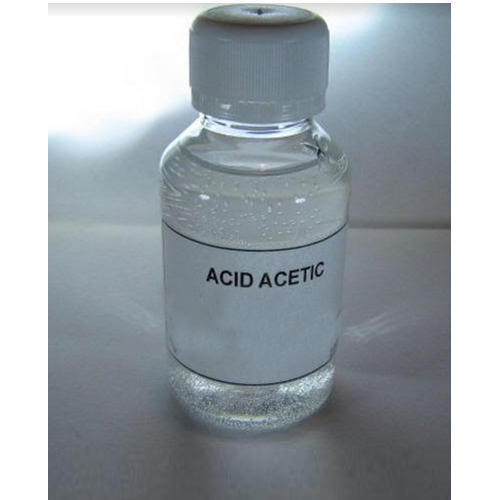
Acetic Acid is an organic compound from the group of carboxylic acids. On an industrial scale, it is obtained by carbonylation of methanol or by oxidation of acetaldehyde. In the food industry, it is manufactured by acetic fermentation from ethanol. Acetic Acid is the main component of vinegar. It is a substance commonly used in the chemical, food and pharmaceutical industries. Another common name for this raw material is ethanoic acid. Its food additive designation is E260.
Acetic Acid is a clear colorless liquid with a pungent odor. It is soluble in water and is characterized by its high hygroscopicity. Acetic Acid is highly corrosive, therefore is usually used in dilute form. Different names do have use for its solutions depending on the degree of dilution. A solution with a concentration of 70% – 80% is called Acetic Essence, while a solution containing 6% – 10% Acetic Acid is called vinegar. Swiss Milks offers Acetic Acid in a concentration of 25% – 90%. As the chemical reagent occurs acidic in nature, it has preserving properties used in food production, and it is also a pH regulator and flavor enhancer.
| Physical and chemical properties | Value |
|---|---|
| Appearance | Clear colourless liquid |
| pH value | 2.5 (50 g/l, H₂O, 20°C) |
| Colour | 16 max APHA |
| Boiling point | 116-118°C (1013 hPa) |
| Density | 1.04 g/cm³ (25°C) |
| Explosion limit | 4-19.9% (V) |
| Flash point | 39°C |
| Heavy metals (as Pb) | 0.8 ppm max |
| Iron (Fe) | 0.8 ppm max |
| Chlorides | 0.8 ppm max |
| Sulphates | 0.8 ppm max |
| Sulphurous acid | 0.8 ppm max |
| Acetaldehyde | 400 ppm max |
| Formic acid | 1600 ppm max |
| Total chlorine | 16 ppm max |
| Purity | 79.0-79.9% |
| CAS Number | -19-7 |
| Kinematic viscosity | -1.17 mm²/s (20°C) |
| Solubility | 602.9 g/l soluble |